


How to Build a Customer Review System That Grows Your Business
Most businesses don't have a bad review problem.
They have a review collection problem.
I've talked with business owners who stress over one negative review while ignoring the fact that they've only collected six reviews in the last three years.
If that's you, I have good news.
One bad review isn't costing you customers, having almost no reviews is.
People don't expect perfection anymore, but they do expect proof. Before someone hires you, they want to know if real people have worked with you, had a good experience, and would recommend your business.
Reviews aren't just nice to have, they're one of the simplest and lowest-cost marketing tools you can build.
They help people trust your business.
Help you show up in search results.
Help your sales team answer questions before they're even asked.
Most importantly, they keep working long after they're posted.
A Google ad stops working the moment you stop paying for it, while a good review can help you win customers for years.
In case you want to jump to a specific section:
The First Time I Saw the Power of Reviews
Reviews Build Trust Before You Ever Talk to a Customer
Choose One Place to Build Your Reputation
Third-Party Reviews Matter & Why Options Are Recommended
Why Review Suppression Is the Wrong Goal
Your Response Matters More Than the Negative Review
Build a Review System That Runs Itself
Frequently Asked Questions (FAQs)
What is the best review platform for a small business?
How often should I ask customers for reviews?
Should I ask every customer or only happy customers?
What should I do if I get a negative review?
Should I respond to positive reviews?
Do I need review management software?
The First Time I Saw the Power of Reviews
The first time I really understood the value of customer reviews wasn't while helping a local business, It was actually early in my marketing career at a cybersecurity start-up that got acquired back in 2018.
I managed account-based marketing programs, and one day our sales team came to marketing with a problem. They kept losing deals to competitors.
We looked at pricing.
Looked at features.
Then at messaging.
None of those were the real problem, what we realized was that our competitors had more customer reviews and had built stronger customer reference programs. When buyers compared us, they saw more proof that other companies trusted our competitors. That proof gave buyers confidence.
So instead of creating another marketing campaign, I partnered with our customer marketing team to build a review and customer reference program.
In about 2-3 months, we collected more than 100 customer reviews.
More importantly, we built a simple process that kept bringing in reviews and customer references, and in some instances rewarded customers for submitting reviews.
That experience changed how I think about marketing, because the best marketing didn't come from our buttoned up website, webinars, it actually came from our customers. And as an added benefit we were then able to come up with creative ways to expand the reach of these reviews, through creating new case studies, social proof sections on our website, leverage favorable reviews in promotional videos, and more.

Reviews Build Trust Before You Ever Talk to a Customer
Think about the last time you made a big purchase or hired someone.
Maybe you needed a roofer or a new dentist?
Perhaps you were looking for a new software tool.
You probably didn't visit their website first, most likely you
Searched Google.
Looked at the star rating.
Read a few reviews.
Only then did you decide whether they were worth a call, or booking some time with.
Your customers do the exact same thing, thats why reviews matter so much. They answer questions your website can't answer without bias.
Did this business do what they promised?
Were they easy to work with?
Did they solve the problem?
Would customers hire them again?
That's the kind of proof people trust.
Choose One Place to Build Your Reputation

One of the biggest mistakes I see is businesses asking for reviews everywhere.
A few customers leave Google reviews, someone else leaves a Facebook review, while another customer writes a Yelp review, some even send a nice email that nobody else will ever see. Now your reputation is spread across five different places.
Instead, choose one platform as your main focus.
For almost every local business I work with, that's a Google Business Profile. Why?
Because Google is where your customers are already searching.
When someone searches for a plumber, HVAC company, lawyer, accountant, marketing agency, or almost any local service, Google often shows business listings before websites.
Your reviews are right there in the search results, which means people see your reputation before they ever click your website.
That's incredibly powerful because every new review helps build trust, before customers decide to give you a call. It can also help improve your visibility in local search, which means more people discover your business in the first place.
Think of Google reviews as part of your full marketing strategy, not just your customer service strategy.
Third-Party Reviews Matter & Why Options Are Recommended

You should absolutely share customer testimonials on your website, but don't stop there. People know you control what appears on your own website, but when you use third-party review sites that your business don't have full control over...every review becomes so much more valuable.
Prospective customers know they're seeing real feedback from real customers.
"Your website is where you tell people you're great.
Google is where your customers tell people you're great."
Guess which one people believe more?
Although I recommend Google Business Profile reviews be your main focus, not every customer wants to leave a review through Google.
That's okay, and I usually recommend giving customers one or two backup options that are a little more easy or accessible. Facebook is a good choice because many people already have an account, and facebook page reviews are relatively easy to submit.
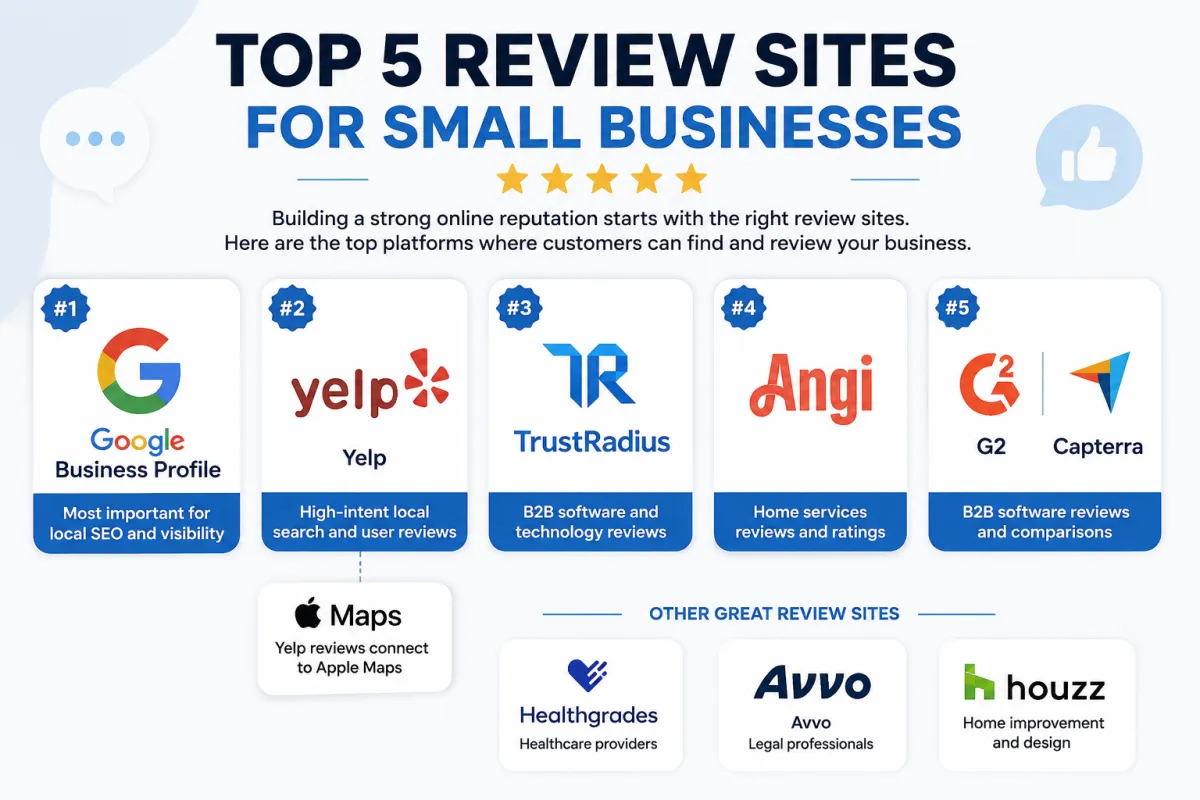
Businesses in other industries may get better results from platforms like Yelp, G2, Capterra, Healthgrades, Avvo, Houzz, or Angi. The goal isn't to collect reviews on every website you can find, it should be to make it easy for customers to leave a review on a trusted platform they already use.
A handful of strong review profiles is much better than dozens of half-finished ones.

Why Review Suppression Is the Wrong Goal
Let's talk about the elephant in the room.
Nobody likes getting a bad review.
It doesn't matter how hard you work or how much you care about your customers, at some point someone is going to have a bad experience. That's part of running a business.
The mistake many businesses make is treating every negative review like an emergency. The thoughts that immediately come to mind...
Can I delete it?
Is there a way to hide it?
Should I report the reviewer?
What can I say to convince the customer to take it down?
All fair questions, and if a review is fake, spam, or breaks the rules of the review platform, you should definitely report it.
But if it's from a real customer sharing their experience, trying to hide it isn't the right answer. After addressing the customer's concern, ask yourself a better question.
Why does this one review feel so damaging?
For many businesses, the reality is that one bad review feels huge when you only have a handful of reviews.
Build a steady flow of honest reviews, and one negative review becomes just one small part of your overall reputation that gets drowned out with more favorable reviews. It's honestly one of the few areas in business that is a numbers game.
Your Response Matters More Than the Negative Review
Here's something that surprises a lot of business owners.
A few negative reviews can actually help build trust. Customers don't expect perfection anymore, they expect honesty. To take things a step further, perfect five-star ratings make people suspicious.
Think about it, have you ever looked at a business with hundreds of perfect reviews and wondered if they were real?
Most people have, and customers know that no business is perfect.
They expect to see a few complaints, but what they really pay attention to is how you respond.
Did you stay professional?
Did you try to fix the problem?
Did you take responsibility when you made a mistake?
What people really watch is how you respond. It often says more about your business than the review itself, I've seen businesses earn new customers because of how they handled a negative review.
And to be honest, that's the kind of trust you can't buy through Ads.
Nobody enjoys reading a one-star review, but every review gives you a chance to show future customers how you do business.
When you respond with respect, you aren't just talking to the unhappy customer. You're talking to everyone who reads that review later.
Reply with three goals in mind.
Thank the customer for taking the time to leave feedback.
Acknowledge the issue without becoming defensive.
Explain what you're doing to make things right for this customer and to prevent future issues, if it's appropriate.
Keep it short.
Be respectful.
And never argue in public.
If the conversation needs to continue, invite the customer to contact you directly so you can work toward a solution.
Future customers notice when you care enough to respond.

Build a Review System That Runs Itself
One thing I've learnt from building review programs and really every type of growth campaign, is that a campaign ends, while building a system keeps things going long after the investment of time, money and effort.
Too many businesses treat reviews like a one-time project.
They send one email asking for reviews, and maybe get a few responses. But quickly move on to the next shinny marketing idea.
But requesting reviews is an important part of your customer journey, and should happen for EVERY:
Completed project.
Finished service call.
Successful onboarding.
Happy customer.
These moments are perfect opportunities to ask for a review, especially if you haven't received one from that customer on that platform yet. When review requests become part of your process instead of an afterthought, your reputation grows month after month.
A Simple Review Engine/System
This is the simple framework I recommend to most clients, but please customize for your specific use-case.
Step 1: Do Great Work.
Nothing beats doing great work. Happy customers leave the best reviews.Step 2: Ask Every Customer
Don't try to predict who will leave five stars. Ask everyone for an honest review. Send one text or email with a direct review link. The fewer clicks, the better. Make sure you're tracking review completions from customers so that you can exclude them from requests in the future or customize the request so they leave reviews on other platforms.Step 3: Put Reviews to Work
Thank customers for positive reviews, respond professionally to negative ones and be as genuine as possible. People notice. Don't let your best reviews just sit on Google... add them to your website, service pages, proposals, email newsletters, and your social media content flow. Turn your strongest reviews into testimonials, case studies, and customer success stories that do more than boost your rating. Reviews should help grow your business.
Then rinse and repeat!
Frequently Asked Questions (FAQs)
What is the best review platform for a small business?
I recommend making Google Business Profile your primary review platform. That's where many customers start their search, and your reviews appear directly in Google's search results and Google Maps. Also offer one or two backup options for customers who don't use Google. Facebook Reviews are a good choices for many businesses, or industry-specific platforms like G2, Capterra, Yelp (Integrated Into Apple Maps), Healthgrades, Avvo, Houzz, or Angi. The goal isn't to collect reviews everywhere. It's to build a strong reputation on the platforms your customers already trust.
How often should I ask customers for reviews?
Ask every customer after you've delivered value. That could be after completing a project, finishing a service call, wrapping up an onboarding, or solving a support issue. The closer you ask to a positive experience, the more likely customers are to leave a review.
Should I ask every customer or only happy customers?
A every customer for an honest review. Trying to guess who will leave five stars can create a biased review profile and may violate the policies of some review platforms. A steady stream of honest reviews builds more trust than trying to maintain a perfect rating. It's also easier to automate.
What should I do if I get a negative review?
First, don't panic. If the review is from a real customer, respond professionally, acknowledge their experience, and offer to continue the conversation privately if needed. If the review is fake, spam, or clearly violates the platform's policies, report it through the appropriate review platform. One negative review rarely hurts a business that consistently collects positive reviews.
Should I respond to positive reviews?
Yes. A simple thank-you shows customers that you appreciate their feedback and that you're paying attention. It also encourages future customers to leave reviews because they know someone is listening.
Do I need review management software?
No. You can get started with a Google review link and a simple email or text message. As your business grows, software can help automate review requests and save time, but having a consistent process is much more important than the software you choose.
Is review suppression a good idea?
In most cases, no. If a review is fake, spam, or violates the platform's policies, it's appropriate to report it. But if it's honest feedback from a real customer, your time is usually better spent responding professionally and continuing to collect more authentic reviews. Over time, your overall reputation will matter far more than one unhappy customer.
Next Steps
If you're ready to build a review system for your business, here's where I'd start:
Claim or verify your Google Business Profile if you haven't already.
Choose one backup review platform that makes sense for your industry.
Create a direct review link so customers don't have to search for your business.
Add review requests to your customer workflow so every customer gets asked at the right time. It can be a simple email or text that gets automatically sent out.
Reply to every review—both positive and negative.
Share your best reviews on your website, social media, and sales materials.
You don't need to do everything today, just start with one small improvement, then build from there.
If you're looking for an easy way to automate the process, I personally use and recommend GoHighLevel's Reputation Management tools. It's honestly the only all-in one platform you need to run your business. It's a CRM, website builder/host, email and sms automation tool, and have integrations built in to do so much more. They also make it easy to send review requests by text or email, monitor your reviews, and build review collection into your normal customer workflow.
Full disclosure: I'm a GoHighLevel affiliate, so if you sign up using my referral link, I'll personally help you get everything set up and answer your questions along the way. I also offer lifetime 15-minute support calls to my referral partners, so if you ever need help down the road, I'm happy to jump on a quick call.
Remember, the goal isn't to build a perfect five-star reputation... it's to build a business that earns trust one happy customer and one honest review at a time.


